
Beskrivning
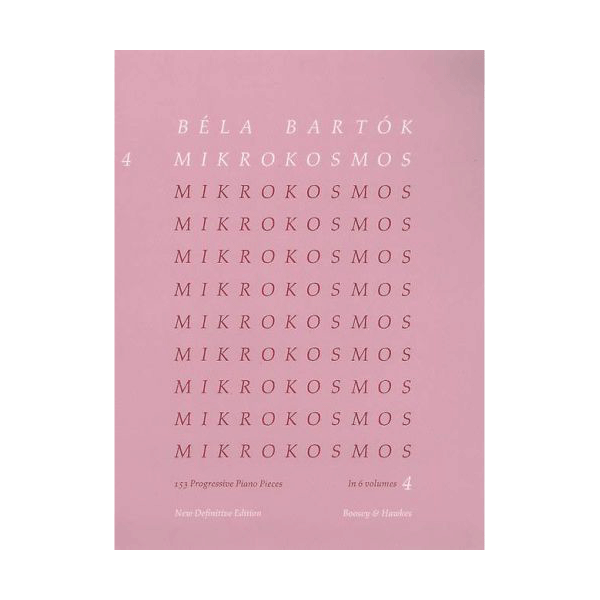
Mikrokosmos 4
Bela Bartok

Binding: Saddle stitching
Difficulty: intermediate
Publisher: Boosey & Hawkes, London
Page number: 56
Information från utgivaren om: Mikrokosmos 4
Traversing Bartók’s Mikrokosmos is like growing up: The evolution from utter beginner’s level pieces, as presented in the first two dozen or so works from Volume 1, to the virtuoso fare of the last two books, is ever so gradually and magically wrought. Bartók put more works into the first three (of six) volumes, cognizant certain elementary lessons would have to be thoroughly absorbed by the student before moving onto more advanced issues. Thus 96 pieces comprise the first half of this set, leaving only 57 spread among the final three volumes. But the works grow longer as one progresses through the collection: Volume 4 here, in fact, with but 25 pieces, is the longest in duration of any of the six.
It also features some of the finest music. With its mixture of pedagogical-sounding and folk-like/pastoral titles, it offers both greater color for the listener and greater challenge for the student than the works in the first three volumes. It leads off with Notturno (No. 97), a tribute to Chopin, wherein Bartók presents the listener with a rather updated take on that great master’s style, particularly as it related to his nocturnes. Another ”homage” in this volume comes with Bourrée (No. 117), a sunny, colorful work styled after the dance music of the French composer François Couperin (1668 – 1733).
With regard to the works housed under ”pedagogical-sounding” titles, Hands Crossing (No. 99) may seem to describe a dry exercise, but its ”Night Music”-like theme and atmosphere will appeal to most listeners, although its challenges may at first seem trying to the student. Bartók delved into many other technical issues in this volume, and loved to deal with them in his always-inventive and often-challenging contrapuntal writing. Minor and Major (No. 102), Children’s Song (No. 106), Theme and Inversion (No. 114), and Dance in 3/4 Time (No. 119) are some of the more prominent examples. But these pieces, as most of their titles disclose, also examine other crucial keyboard matters.
Bartók’s seemingly irrepressible urge to adapt folk music flowers in a number of works in this volume, including the playful In the Style of a Folksong (No. 100) — which, despite its title, really uses Balkan folk material — the aforementioned Children’s Song (No. 106), an attractive but hardly childlike piece, and several other pieces including Variations on a Folk Tune (No. 112), and Bulgarian Rhythms I & II (Nos. 113 and 115, respectively). Bulgarian Rhythm I is unusual in that it uses a Hungarian theme over a driving, spicy Bulgarian rhythm. All these ethnic-inspired works challenge the student in the same way the more pedagogically titled pieces do, notably in the areas of rhythm, fingering, touch, and in developing a strong interpretive sense.
Innehåll för: Mikrokosmos 4
Foreword to the Definitive Edition
Preface by the Composer
Notturno
Thumbs Under
Hands Crossing
In Folk Song Style
Diminished Fifth
Harmonics
Minor and Major
Wandering through the Key
Game (with two five-tone scales)
Children’s Song
Melody in the Mist
Wrestling
From the Island of Bali
And the Sounds Clash and Clang…
Intermezzo
Variations on a Folk Tune
Bulgarian Rhythm (1)
Theme and Inversion
Bulgarian Rhythm (2)
Song
Bourée
Triplets in 9/8 Time
Dance in 3/4 Time
Triads
Two-part Study
Appendix: Exercises
Appendix: Notes